The LH₂CRAFT project has reached an important safety milestone with the successful completion of the Quantitative Risk Assessment (QRA) for its liquid hydrogen storage demonstrator.
Led by University of Strathclyde (UoS) under Task 8.4, the study evaluated critical hazards associated with the demonstrator’s detailed design, assembly, functionality testing and operation. Its findings provide essential input for optimising the demonstrator and supporting the final detailed design developed within Work Package 4.
Building on the conceptual designs and the findings of the HAZID study conducted under Task 8.2, the QRA examined eight critical scenarios:
- Fire and explosion through the pressure relief system.
- Fire and explosion during tank operations.
- Risks associated with incorrect pressure relief valve sizing.
- Hydrogen dispersion following collision, grounding or tank damage.
- Hydrogen releases from the vent masts.
- The location and effectiveness of ventilation systems.
- LH₂ releases on the weather deck.
- Safety-zone requirements during cargo loading and unloading.

Figure 1: QRA scenarios identified through the Task 8.2 HAZID study
Advanced computational methods, including Computational Fluid Dynamics simulations, were used to assess hydrogen dispersion, fire and explosion risks under different operational and environmental conditions.
The assessment produced several important findings and design recommendations. These included maintaining appropriate vent mast spacing and orientation, ensuring sufficient spatial separation to reduce thermal impacts, accounting for wind conditions when assessing hydrogen dispersion, and preventing hazardous atmospheres from reaching crew-occupied or critical areas.
The study also recommended establishing a 16-metre hazard zone around the cargo compressor room vent fan, using explosion-proof equipment and excluding ignition sources within this area. For cargo operations—particularly unloading—the findings highlighted the potential need for additional measures, such as secondary barriers or mitigation systems.
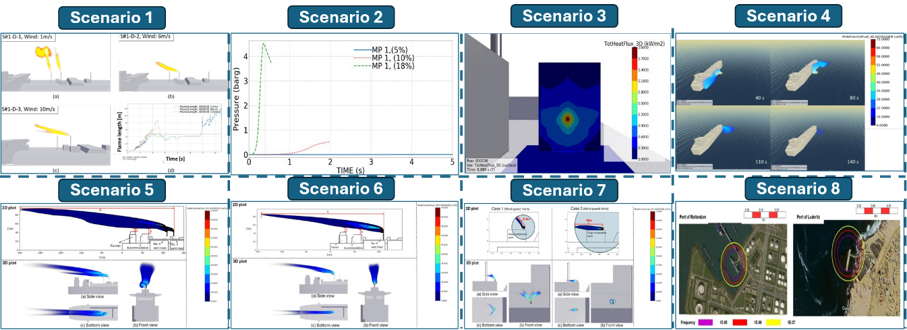
Figure 2: Summary of the risk assessment results for the eight QRA scenarios
The methodology, analysed hazards, results and recommendations were documented in Deliverable D8.3 and provided as technical input for the demonstrator’s final detailed design.
The QRA results were submitted as part of the Approval in Principle process for the LH₂ Cargo Containment System, supporting its assessment against the relevant classification society requirements.
In addition, the principal findings and recommendations were consolidated in an Information paper submitted to the International Maritime Organization under the sponsorship of the Italian Flag Administration. This represents an important project achievement, bringing technical evidence generated through LH₂CRAFT into international regulatory discussions and supporting the continuing development of safety guidance for alternative-fuelled vessels.
If new hazard scenarios are identified as the demonstrator progresses, additional QRA studies may be conducted to support its continued safe development and operation.