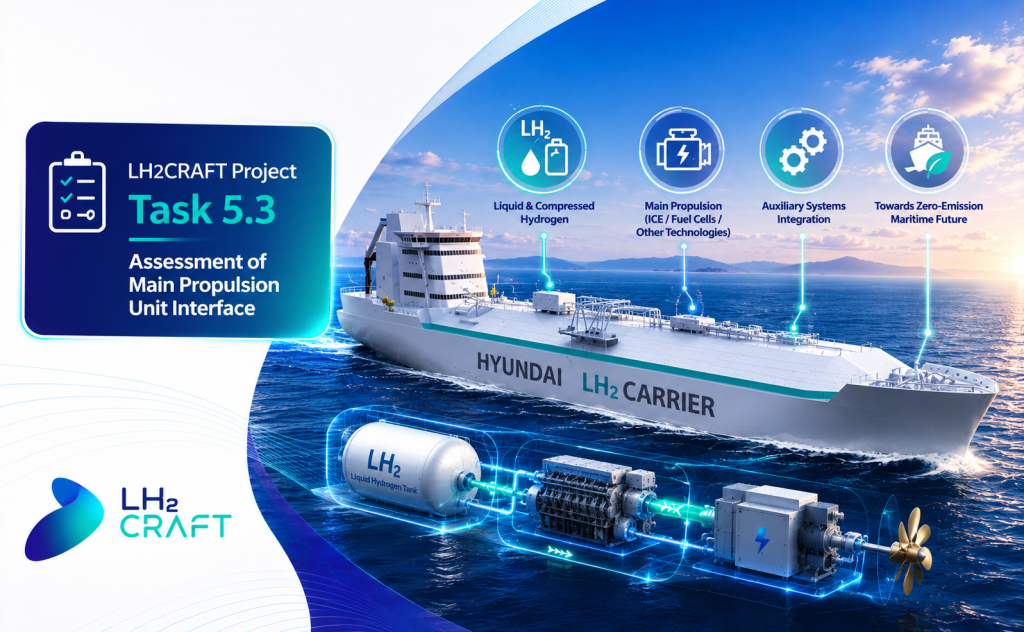
As part of the LH2CRAFT project’s ongoing work towards safe and efficient liquid hydrogen solutions for maritime applications, Task 5.3, titled “Assessment of Main Propulsion Unit Interface,” will investigate the application of hydrogen as a fuel for marine propulsion.
Led by the School of Naval Architecture and Marine Engineering – NTUA, this task will look beyond hydrogen storage and examine current trends in the use of both liquid hydrogen and compressed gaseous hydrogen across a range of propulsion technologies. These include Internal Combustion Engines, Fuel Cells, and other eligible systems with potential relevance for the maritime sector.
The work will explore the operational aspects, integration requirements, and technical challenges associated with hydrogen-based propulsion systems. Particular attention will be given to the interface between the main propulsion unit and the necessary auxiliary equipment, ensuring that the analysis reflects real maritime operating conditions and current industry developments.
Task 5.3 will also review existing and emerging maritime applications, while considering alternative hydrogen carrier solutions, such as Liquid Organic Hydrogen Carriers, and assessing their potential implementation within the marine industry.
The study will be carried out in accordance with the technological readiness of each system and will be based on available literature, industry sources, and current maritime practice.
Scheduled to run from Month 28 to Month 38, the findings of this task will be consolidated in Deliverable D5.2, “Main Propulsion Unit Interface.” Through this work, LH2CRAFT will contribute to a clearer understanding of how hydrogen propulsion technologies can be effectively integrated into future marine systems.