Understanding the environmental impact of new technologies is essential to ensuring that the transition towards cleaner maritime transport is truly sustainable. As part of LH2CRAFT’s efforts to develop innovative solutions for the safe and efficient transportation of liquid hydrogen, the project is assessing the environmental performance of its cargo containment systems.
Under Task 10.1 – Life Cycle Assessment of Solutions, led by the University of Strathclyde (UoS), a Life Cycle Assessment (LCA) framework has been developed to evaluate the environmental impacts of cargo containment systems throughout their entire life cycle.
The framework follows a cradle-to-grave approach, covering all major stages, from raw material extraction and transportation to manufacturing, installation, operation, maintenance, and eventual scrapping. The assessment also considers key emissions and their associated environmental impacts, as illustrated in the figure below.
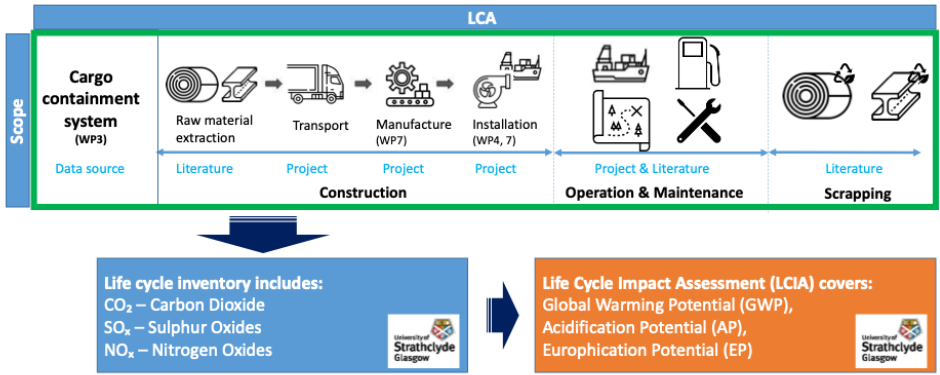
Figure 1. Life Cycle Assessment (LCA) framework developed by the University of Strathclyde, illustrating the assessment scope, data sources, life cycle inventory and environmental impact categories considered.
Building on this framework, the University of Strathclyde (UoS) team has conducted a preliminary LCA of the demonstrator’s membrane-type cargo containment tank. The assessment includes an inventory of key emissions, such as carbon dioxide (CO₂), sulphur oxides (SOₓ), and nitrogen oxides (NOₓ), and evaluates three environmental impact categories:
- Global Warming Potential (GWP): The contribution to climate change.
- Acidification Potential (AP): The potential of emissions such as sulphur and nitrogen oxides to acidify soil and water.
- Eutrophication Potential (EP): The potential impact of nutrient enrichment on aquatic ecosystems.
The preliminary assessment has established an initial environmental impact baseline for the membrane-type demonstrator tank. In parallel, data requirements have been identified for assessing Type-C tanks, particularly regarding their weight and material composition.
Looking ahead, the University of Strathclyde (UoS) team will conduct sensitivity analyses for the demonstrator tank, continue collecting material and weight data for Type-C tanks across the desktop vessel studies, and develop assessment scenarios using available literature where detailed information is not yet available.
The outcomes of Task 10.1 will contribute to the project’s wider sustainability evaluation, providing an environmental baseline for assessing the solutions developed under Work Packages 3–7. The findings will also support the overall evaluation activities under WP10 and alignment with the project’s Key Performance Indicators (KPIs) established under Task 2.4.
Through this work, LH2CRAFT continues to integrate environmental considerations into the development and evaluation of innovative liquid hydrogen transportation technologies.