Within LH₂CRAFT, the engineering development of the Liquid Hydrogen Handling, Distribution and Management Safety System (HDMSS) led by HYDRUS, has reached an important milestone, with the finalisation of its basic and detailed design during the second reporting period and the subsequent receipt of Approval in Principle.
The engineering work established a comprehensive technical framework covering process flow diagrams, piping and instrumentation diagrams (P&IDs), system architecture, operational modes and technical requirements. Essential safety arrangements—including gas and fire detection, ventilation and emergency shutdown systems—formed an integral part of the design.
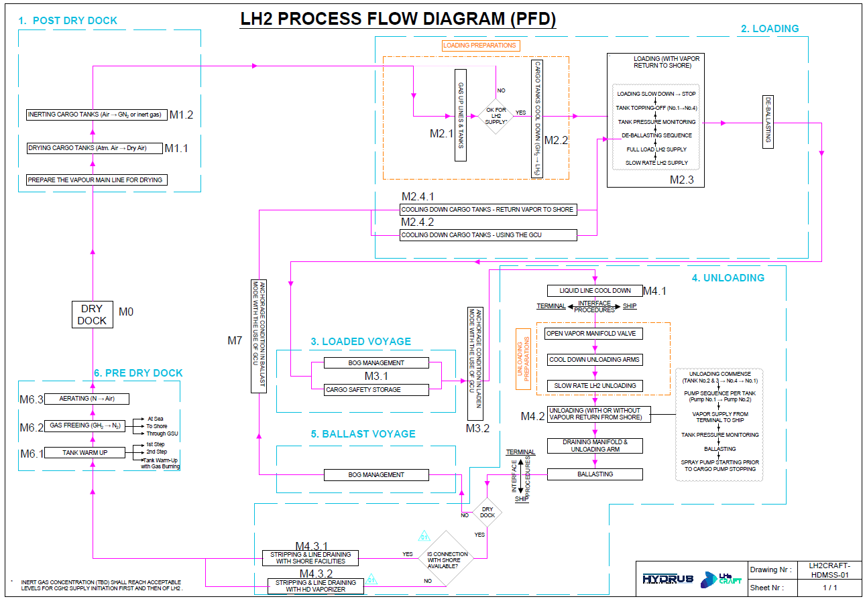
Figure 1. LH2CRAFT process flow diagram
Safety assessments shaped the system throughout its development. Early Hazard Identification (HAZID) activities informed the initial engineering approach, while findings from Hazard and Operability (HAZOP), Failure Modes and Effects Analysis (FMEA), and Quantitative Risk Assessment (QRA) studies were progressively incorporated into the documentation.
As the design matured, the work addressed cryogenic piping layouts, thermal insulation and thermal management, alongside analyses of system performance and structural behaviour under liquid hydrogen operating conditions.
Digital models examined loading and unloading sequences, pressure distribution across the piping network and conditions that could lead to localised hydrogen evaporation. The simulations showed that elevation differences within the system had a greater influence on pressure losses than fluid friction, providing useful insights for future design optimisation.
Complementary preliminary stress analyses indicated that the cryogenic piping could withstand the combined effects of thermal contraction and internal pressure. The highest stresses occurred at expected locations, such as pipe bends, helping the engineering team identify areas for further refinement.
The engineering package was submitted to the classification society for independent assessment. Following technical review, the HDMSS received Approval in Principle, marking an important recognition of the design approach and its engineering and safety basis.
Together, these achievements establish a strong technical foundation for LH₂CRAFT’s upcoming validation activities and contribute knowledge to support the further development of liquid hydrogen systems for maritime transport.